

 This is the final installment of our series on thoughtful classroom design, where we’ll speak with Holly Light, a special education teacher who specializes in orthopedic impairments and is also an RN! The entirety of the series is linked at the bottom of this post. We hope you’ve enjoyed it!
As we conclude this series on flexible classroom design, it’s important to ground design principles in lived experience (as we always do here at Artcobell). Holly Light, an itinerant teacher of students with orthopedic impairments (OI), brings more than 27 years of experience working across general education, special day classes, and early childhood through transition-age settings. Her work centers on one core principle: access.
“A lot of the focus for OI is accessibility for the student,” Holly explains. “And that’s broad—it covers a wide variety of things.”
From mobility to communication to cognitive supports, Holly sees firsthand how classroom design can either remove barriers or unintentionally create them. Her insights offer a powerful reminder that flexibility must be intentional. Let’s dive into some of Holly’s observations and recommendations.
Making Room for Movement
When asked how classroom setup affects students who rely on cognitive supports, Light’s response is immediate: “It affects it tremendously.” The first—and often most limiting—factor, is space.
Many of the students Light works with use wheelchairs, walkers, gait trainers, or quad canes. Clear pathways and generous circulation space are essential, particularly in classrooms where students are frequently moving between stations or accessing visual schedules on the wall.
“You can’t have everything just where the student is, keeping them in one place—that never works.”
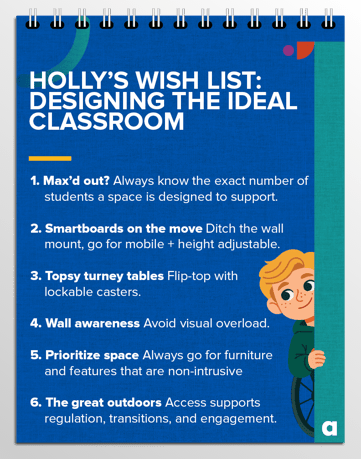
Technology adds another layer of complexity. Interactive boards like smartboards are widely used, but they come with trade-offs. “They’re very valuable,” she says, “but they’re a space hog.” Mounted boards can limit access for students who need adjustable heights, while mobile boards require additional clearance so students—especially wheelchair users—can approach and interact safely.
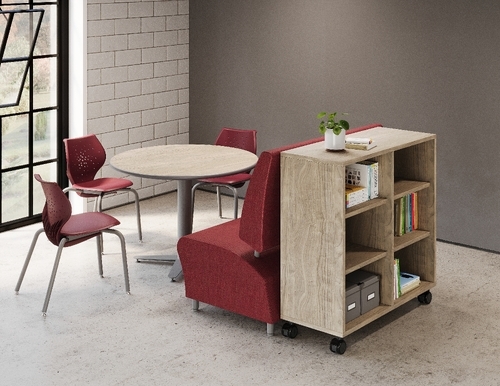
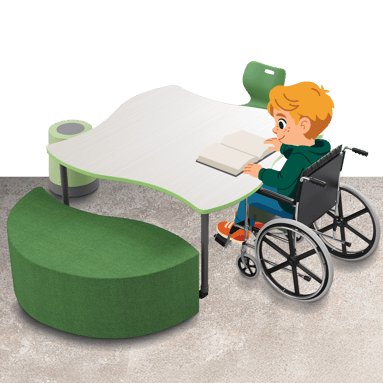
Designing for movement means anticipating how students will navigate the room, not just where furniture fits on a floor plan.
Thoughtful Placement
Cognitive supports are central to learning for many students, but their effectiveness depends on where and how they are placed in the classroom. If not done right, it can turn simple tasks into physical strain for those with limited strength, reach, or endurance. “For a lot of my students, communication support is integral to education,” Light says.
Communication devices can be mounted directly to a wheelchair, which helps with access. But for many others, supports must live on a work surface. “A typical desk usually does not provide enough space,” she says. As a result, she often relies on larger tables or wheelchair-accessible desks to accommodate devices like visual timers, tablets, and calculators.
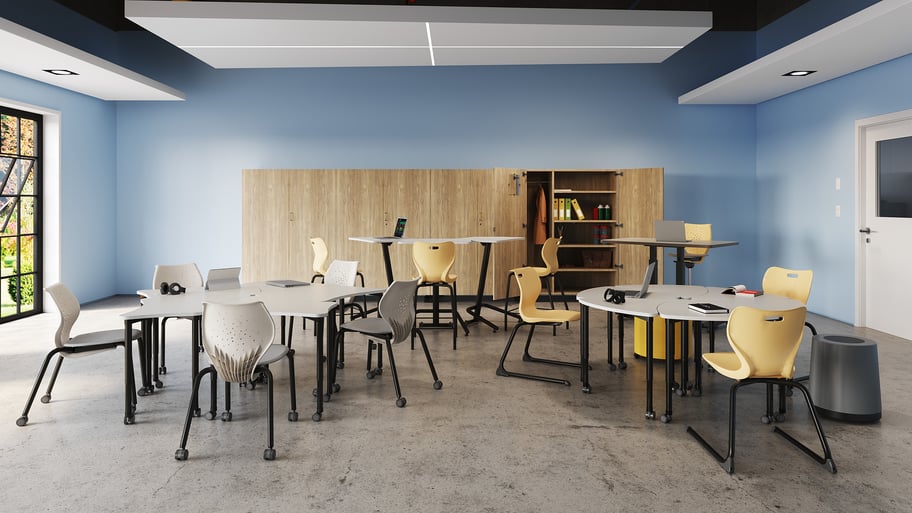
Height matters just as much as surface area, so she’s especially passionate about adjustable furniture. “I love furniture that can be easily height adjusted, and if it’s mobile too, I gravitate toward that because it serves students best.”
She also cautions against visual overload. Environmental print and mounted supports must be balanced carefully. Too much on the walls can affect attention and focus, negatively impacting a student’s cognitive progress.
Supporting Independence Without Distraction
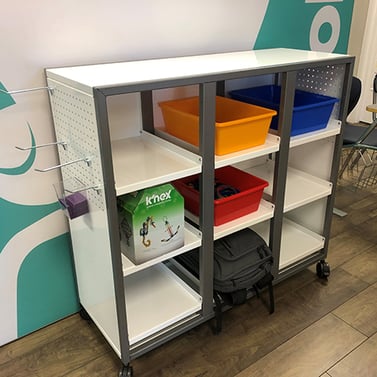
Storage is often overlooked, but Light sees it as critical to accessibility and independence, noting that many adaptive tables either lack storage or include options that are difficult to use. It also plays a role in maintaining focus. “I’ve walked into classrooms where there’s so much out, making kids tempted to engage with things they aren’t supposed to in the moment,” she says.
Proper storage reduces clutter, supports attention, time on task, and student responsibility.
Note that under-desk storage can be inaccessible for wheelchair users and challenging even for ambulatory students. She favors open, front-facing storage that students can see and reach into easily, rather than have to open and peer down into.
 Listen to the Experts in the Room
Light’s perspective reinforces the message woven throughout this series: effective classroom design starts with listening to educators who understand how students actually use space.
“Kids with the biggest challenges to cognitive access are often the same kids who have mobility issues,” she says. “When design supports movement, flexibility, and access, it supports learning—for everyone.”
As architects, designers, and educators continue shaping the future of learning environments, voices like Light’s remind us that inclusive design isn’t about adding more—it’s about designing smarter.
Read the rest of the entries in this series, "Classroom Design for All Learners."
- Through the eyes of an Educator
- Through the eyes of an Occupational Therapist
- Through the eyes of a Speech Therapist
- Through the eyes of a Special Education Teacher
Recent Posts
Let’s meet the children of Through Their Eyes—Artcobell's movement to design learning environments...
Let’s meet the children of Through Their Eyes—Artcobell's movement to design learning environments...